Thesis
The phrase “data is the new oil” appeared as early as 2006, as the data produced by the internet began to take off. Two decades later, the spending that data attracts is being reshaped by AI. As of September 2026, worldwide AI spending was projected to reach $2.7 trillion in 2026, up 49.5% from 2025. Within that, spending on AI data was projected to grow from $826 million in 2025 to $3.1 billion in 2026, and spending on platforms for building data science and machine learning models was projected to grow from $19.4 billion to $26.4 billion.
The systems that store and process that data have been consolidating into the cloud. The worldwide database management market grew 13.4% in 2024 to $119.7 billion, and 64% of that spending went to cloud database services rather than software installed on a company's own servers. AI is also changing who creates the databases. Supabase, a hosted Postgres provider, reported in October 2026 that it was launching more than one million databases a week, and described AI agents as "spinning up millions of databases" for the applications they build.
Databricks provides a cloud platform where companies store, process, govern, and analyze data and build AI agents and applications. It was founded by the creators of open-source projects including Apache Spark, Delta Lake, and MLflow, and began as a managed version of Spark for processing large datasets in data lakes. Its architecture, which it calls a lakehouse, combines the low-cost storage of a data lake with the management features of a data warehouse. As of October 2026, the company branded its platform as the “Databricks Data + AI Platform”, which spans data engineering, data warehousing, an operational database, governance, and tools for building AI agents. By keeping storage, governance, and AI tooling in one place, Databricks aims to let a company build AI on its own data without moving that data between systems.
Subscribe to the Research Rundown
Subscribe for a weekly digest on the best private technology companies.
Founding Story
Databricks was founded in 2013 by seven UC Berkeley researchers: Ali Ghodsi (CEO), Ion Stoica (Executive Chair and former CEO), Matei Zaharia (CTO), Patrick Wendell (VP of Engineering), Reynold Xin (Chief Architect), Andy Konwinski, and Arsalan Tavakoli-Shiraji (SVP of Field Engineering).

Source: Forbes
Ghodsi and his family fled Iran in 1984 due to the Iranian Revolution, when he was five. They settled in Stockholm, Sweden, moving between student dormitories and neighborhoods. When he was in fourth grade, his parents bought him a used Commodore 64, which became his source of entertainment and also spurred his curiosity. He started reading the manuals that came with the computer and became a self-taught programmer. In 2009, Ghodsi came to the United States as a visiting scholar at UC Berkeley, where he got his exposure to Silicon Valley.
Ghodsi joined Matei Zaharia, then a Ph.D. student, on a project to build a software engine that they dubbed Spark for data processing. Spark began in 2009 as a research project in Berkeley's AMPLab, led by Zaharia. It was designed around a weakness of the MapReduce systems then used to process large datasets, which wrote intermediate results to disk at every stage and so made repeated passes over the same data slow. This project set a world record for the speed of data sorting in 2014 and won Zaharia an award for the year’s best computer science dissertation.
Eager for companies to use their tool, they released the code for free but soon realized it wasn’t gaining any real traction. Over a series of meetings at Indian restaurants beginning in 2012, the seven academics agreed to join together to found Databricks. Entrepreneurial advice for the startup came from Zaharia’s thesis advisors, Scott Shenker and Ion Stoica, two well-respected academics. Stoica was an executive at video streaming startup Conviva, while Shenker had been the first CEO at Nicira, a networking firm sold in 2012 to VMware for about $1.3 billion. Stoica became the CEO, and Zaharia became the chief technologist. Shenker, who joined the board rather than working full-time for the company, arranged the initial meeting between Andreessen Horowitz's Ben Horowitz, an early Nicira investor, and the team.
Andreessen Horowitz invested $14 million in the company's first round in September 2013. In 2015, Ion Stoica had to step away from his role as CEO to fulfill his commitments as a professor at Berkeley, and Ghodsi, who had run engineering and product management, became CEO in January 2016. As of October 2026, the executive team included Dave Conte (CFO), who joined in 2019 after eight years as CFO of Splunk; Hatim Shafique (COO), in the role since 2022; and Andy Kofoid (President, Global Field Operations), who joined the company in 2021.
Product
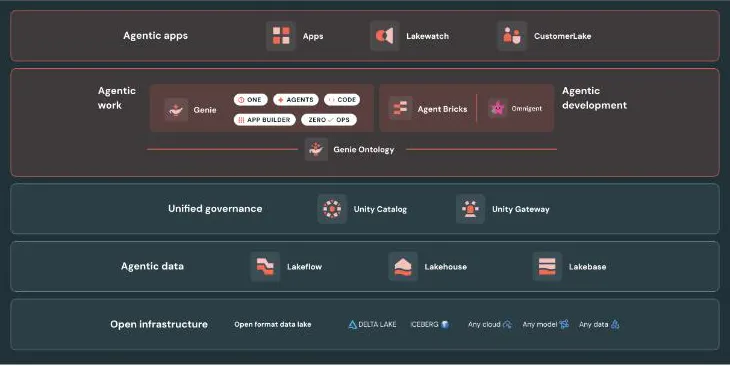
Source: Databricks
Databricks provides the Databricks Data + AI Platform, a single cloud platform on which a company stores, processes, governs, and analyzes its data, and builds AI agents and applications on that data. The company describes the platform as formerly called the Databricks Lakehouse Platform and the Data Intelligence Platform. It runs on AWS, Microsoft Azure, and Google Cloud, and Databricks's own diagram organizes it into five layers, with open storage at the bottom, then data products, governance, and AI tools for business users and developers, and applications at the top.
The bottom layer is the customer's data, stored in the customer's cloud storage in two open table formats. One is Delta Lake, which Databricks created, and the other is Apache Iceberg, whose creators joined Databricks in June 2024 after Databricks agreed to acquire Tabular. Databricks lists Apache Spark, Delta Lake, Unity Catalog, and MLflow among the open-source projects it created. This combination of data lake storage with data warehouse features is the lakehouse. Databricks describes it as having the flexibility, cost-efficiency, and scale of data lakes and the data management and reliable transactions of data warehouses, so business intelligence and machine learning can run on the same data.
Lakeflow

Source: Databricks
Lakeflow is Databricks' data engineering product for ingesting data, transforming it, and orchestrating the pipelines that move it. It combines Lakeflow Connect, a set of connectors that pull data from databases and business applications; Spark Declarative Pipelines, the product formerly called Delta Live Tables; Lakeflow Jobs, formerly called Workflows; and Lakeflow Designer, a no-code pipeline builder. Data teams use a single API to process batch and streaming data, and Databricks manages the infrastructure underneath. Lakeflow Connect is built on Arcion, a data replication company Databricks agreed to acquire in October 2023, and Databricks made Lakeflow generally available in June 2025.
Lakehouse

Source: Databricks
Lakehouse is Databricks's data warehouse, formerly branded Databricks SQL. It lets analysts run SQL queries and business intelligence workloads directly on lakehouse data using serverless compute and Databricks's Photon query engine, and it can query data held in other databases without copying it. Databricks renamed the SQL section of its workspace to Lakehouse in May 2026. In June 2026, it introduced Lakehouse//RT, a real-time warehouse in beta built on a new engine called Reyden, which the company claimed delivers up to 16x better performance than existing real-time serving systems.
Lakebase
Source: Databricks
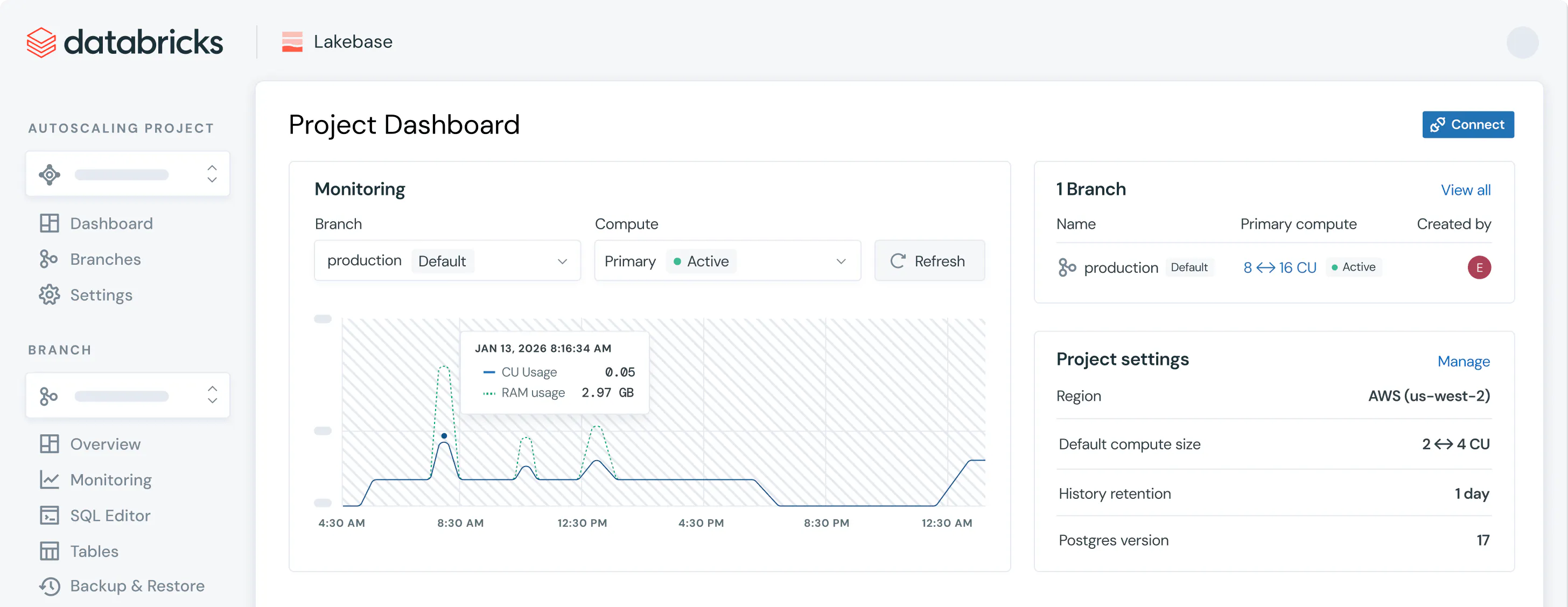
Lakebase is a serverless Postgres database for applications and AI agents, built on technology from Neon, which Databricks agreed to acquire in May 2025 for $1 billion. Databricks launched Lakebase in public preview in June 2025 and made it generally available in January 2026. A Lakebase database scales automatically, down to zero when idle, can be branched like code so a developer or agent can test changes on a copy, and is registered in Unity Catalog alongside the rest of a company's data. In June 2026, Databricks announced Lake Transactional/Analytical Processing (LTAP), an architecture intended to run transactional and analytical workloads on one copy of data stored in the lake, so applications and analytics no longer need separate copies.
Unified Governance
Unity Catalog
Unity Catalog is a unified governance solution for all data and AI assets, including tables, files, machine learning models, agents, and dashboards, across clouds and table formats. Customers can use standard SQL functions to define row filters and column masks, allowing fine-grained access controls on rows and columns, and can trace lineage down to individual columns. Databricks open-sourced Unity Catalog in June 2024 with support from AWS, Google Cloud, Microsoft, and NVIDIA.
Unity Gateway
Unity Gateway governs how a company's employees and agents use AI models. It routes requests across model providers including Anthropic, OpenAI, and Google, enforces budgets and rate limits, masks personal information, and records each request for audit.
OpenSharing and Marketplace
In June 2026, Databricks announced OpenSharing, the successor to its Delta Sharing protocol. Like Delta Sharing, it lets an organization share live data with another organization regardless of which platform the recipient uses, and it extends that sharing to models and other AI assets under a standard hosted by the Linux Foundation. Databricks Marketplace uses the same standard to distribute datasets, models, notebooks, and applications.
Genie One

Source: Databricks
Genie One is Databricks's AI assistant for business users, who use it to ask questions of company data in plain language and get answers governed by the same permissions as the underlying data. Genie began as part of AI/BI, Databricks's business intelligence product, which launched in June 2024 with AI-generated dashboards and a conversational interface. In June 2026, Databricks expanded it into a family of products.
Genie One is an assistant for every employee that runs on the web, mobile, Slack, and Microsoft Teams; Genie Agents are agents built without code for a specific team or task; and Genie Ontology maps a company's business terms, entities, and metrics so the assistant answers in the company's vocabulary. Genie Code, a coding agent for data engineering and data science work, launched in March 2026, and in September 2026, Databricks acquired Row Zero to add governed spreadsheets to Genie.
Agent Bricks
Agent Bricks is Databricks' platform for building, evaluating, and governing AI agents that run on company data. It lets developers choose models from OpenAI, Anthropic, Google, Meta, or open-source providers, build agents in code or without it, and give agents memory backed by Lakebase. Databricks introduced Agent Bricks in beta in June 2025, and at its June 2026 conference it added Omnigent, which runs agents built in outside coding tools such as Claude Code and Codex under Databricks's governance. Databricks's AI tooling traces back to MosaicML, a generative AI training platform it agreed to acquire in June 2023 for what it said was $1.3 billion, including retention packages.
Agentic Apps
Databricks Apps
Databricks Apps lets developers build and host data and AI applications on Databricks' serverless compute, with access governed by Unity Catalog. Databricks made the product generally available in June 2025, when it reported that over 2.5K customers had built more than 20K apps during the preview.
Lakewatch and CustomerLake
In 2026, Databricks introduced applications for two business functions outside the data team, both in private preview. Lakewatch, launched in private preview in March 2026, is a security information and event management product that stores a company's security logs in the lakehouse and uses agents to triage alerts. CustomerLake, launched in private preview in June 2026, is a customer data platform that builds customer profiles from the data a company already holds in Databricks, with early customers including HP, Circle K, and AB InBev.
Market
Customer
Databricks sells to large enterprises, small businesses, and mid-sized companies. As of August 2026, the company reported that more than 20K organizations used Databricks, including 70% of the Fortune 500. It also reported that more than 1K customers were consuming Databricks at an annualized rate above $1 million, and more than 100 above $10 million. It is used across retail, media and entertainment, financial services, energy, healthcare, manufacturing, communications, and the public sector.
Databricks's users have traditionally been data team members, including data engineers, analysts, business intelligence practitioners, data scientists, and machine learning engineers. The Genie products extend the user base to employees outside the data team. Genie has no seat-based pricing and gives organizations up to $10 of free usage per user per month, letting customers roll it out to every employee and pay only for consumption above that.
As of October 2026, customers included Comcast and Block. Comcast credited Databricks with a 10x reduction in its compute costs, and Block, which Databricks reported saved $10 million in productivity with its AI agents. In January 2026, Toyota adopted Databricks as the platform for its company-wide data and AI hub, and in October 2026, FOX Corporation selected Databricks as its multi-year data and AI platform. Databricks also reported that AstraZeneca used Agent Bricks to parse more than 400K clinical-trial documents. Many customers buy Databricks through their cloud provider. Azure Databricks is a first-party Microsoft service billed through Azure, and SAP has sold SAP Databricks inside its Business Data Cloud since February 2025.
Market Size
Databricks's core business sits in the database management market, which grew 13.4% in 2024 to $119.7 billion. Two shifts drove that growth. Cloud database services accounted for 64% of the market's spending, compared with software running on a company's own servers, and spending on nonrelational databases grew 22.7%, roughly twice the 10.8% growth in spending on relational databases.
An adjacent market, platforms for building AI, is smaller but growing faster. As of September 2026, spending on platforms for data science and machine learning was projected to grow from $19.4 billion in 2025 to $26.4 billion in 2026 and $35.6 billion in 2027, and spending on AI application development platforms from $6.9 billion in 2025 to $12.5 billion in 2027. Between 2025 and 2026, Databricks also entered three new markets: operational databases (valued at $70.8 billion in 2024 and projected to grow to $160.6 billion by 2035) with Lakebase, security analytics (valued at $19.6 billion in 2026, projected to grow to $50.4 billion by 2030) with Lakewatch, and marketing data (valued at $120.9 billion in 2024 and projected to hit $202.2 billion by 2030) with CustomerLake.
Competition
Competitive Landscape
Databricks' most direct competitor is Snowflake, and the two have converged from opposite starting points. Historically, Snowflake has had users like business analysts and data engineers, while Databricks has been favored by data scientists and ML engineers. However, the lines have blurred as each company has introduced new products that compete in the other’s domain. Databricks's data warehouse, Lakehouse, competes with Snowflake's core product, and both companies began selling Postgres databases for applications and agents in 2025. For more on the competitive dynamics between Snowflake and Databricks, see our deep dive on the subject.
The cloud providers both distribute Databricks and compete with it. Databricks runs on AWS, Microsoft Azure, and Google Cloud, and each of the three sells its own data platform alongside it. Enterprise software companies have also been buying independent data companies. IBM completed its acquisition of the data streaming company Confluent in March 2026, and SAP completed its acquisition of the lakehouse company Dremio in July 2026. Among independent companies, Fivetran and dbt Labs merged in June 2026, and newer databases such as ClickHouse and Supabase have raised at multi-billion-dollar valuations.
Databricks's claimed advantage is that it owns the whole path from raw data to a deployed agent under one governance layer, while point-solution rivals such as Fivetran, ClickHouse, and Starburst sell one or two parts of it. The contest has also moved from storage formats to catalogs. Databricks supports both Delta Lake and Iceberg and pitches Unity Catalog as the place to govern either, while Apache Polaris, a competing open catalog co-created by Snowflake and Dremio, became a top-level Apache project in March 2026.
Competitors
Independent Data Platforms
ClickHouse: Founded in 2021, ClickHouse provides an open-source, column-oriented database built for real-time analytics, offered as a managed cloud service. ClickHouse raised a $400 million Series D led by Dragoneer at a $15 billion valuation in January 2026. As of October 2026, it had raised a total of $1.2 billion from investors including Dragoneer, Khosla Ventures, Lightspeed, and GIC. ClickHouse competes with Databricks's Lakehouse for real-time analytics workloads and, through a managed Postgres service, with Lakebase.
Supabase: Founded in 2020, Supabase provides a hosted Postgres database with authentication, storage, and other backend services, used heavily by developers and AI coding tools that build applications. Supabase raised a $500 million Series F led by GIC at a $10.5 billion valuation in June 2026, followed by a $150 million round led by GIC in October 2026 at an undisclosed valuation. As of October 2026, it had raised a total of $1.2 billion. Supabase is a direct competitor to Lakebase. Both sell Postgres to agents that create databases automatically, but Supabase sells to developers building applications, while Databricks sells Lakebase to companies whose data already sits in the lakehouse.
Fivetran: Founded in 2012, Fivetran provides managed connectors that move data from business applications and databases into data platforms. In June 2026, it completed an all-stock merger with dbt Labs, the company behind dbt, an open-source tool for transforming data with SQL. Fivetran's last equity round before the merger was a $565 million Series D led by Andreessen Horowitz at a $5.6 billion valuation in September 2021, and as of October 2026, it had raised a total of $853.1 million, separate from the $414.4 million dbt Labs raised. The combined company has not disclosed a valuation. Fivetran and dbt Labs have historically fed both Databricks and Snowflake, and they compete with Lakeflow for the work of loading and transforming data.
Starburst: Founded in 2017, Starburst provides a commercial version of Trino, an open-source query engine that analyzes data where it already sits rather than moving it into one platform. It raised a $250 million Series D led by Alkeon Capital in February 2022. As of October 2026, it had raised a total of $414 million from investors including Andreessen Horowitz, Index Ventures, and Coatue. Starburst's pitch of querying data across many systems is the opposite of Databricks's pitch of consolidating it in one.
Snowflake: Founded in 2012, Snowflake provides a cloud data platform that began as a data warehouse and has added data science, AI, and application tools. In its quarter ended July 2026, it reported product revenue of $1.5 billion, up 37% year over year, a net revenue retention rate of 126%, and 828 customers spending more than $1 million a year. Snowflake had a market cap of $114.7 billion as of October 2026. It released a Postgres database in public preview in December 2025, built on its acquisition of Crunchy Data, and signed a $200 million partnership with OpenAI in February 2026, mirroring Databricks's moves. Snowflake is often considered a closed platform because its software is proprietary rather than open source, while Databricks built on open-source projects and open formats in the customer's own storage.
Palantir: Founded in 2003, Palantir provides software platforms that model a company's operations as a structured map of its objects and relationships and build AI applications on that map, mostly for governments and large enterprises. Palantir had a market cap of $472.8 billion as of October 2026. Palantir competes with Databricks for the layer where AI applications are built on enterprise data, but the two partnered in March 2025 to connect Palantir's platform to data governed in Databricks, with the US Department of Defense among joint customers.
Cloud Providers and Enterprise Software Suites
Microsoft: Microsoft’s competing offering to Databricks is Fabric, an analytics platform built on a shared data lake called OneLake, which had more than 40K paid customers as of July 2026, up more than 60% year over year. Microsoft also distributes Databricks, which it sells as Azure Databricks, a first-party Azure service.
Google: Google’s product BigQuery was repositioned in April 2026 as an Iceberg-based lakehouse with data engineering and data science agents, including previews that read data catalogs held in Databricks and Snowflake. Google also partners with Databricks, and since June 2025, Google's Gemini models have run natively on Databricks.
Amazon: Amazon provides a lakehouse through Amazon SageMaker, which unifies data in Amazon S3, S3 Tables, and the Redshift data warehouse and is compatible with Apache Iceberg. AWS also distributes Databricks, and Databricks reported in October 2024 that its AWS business had passed a $1 billion run-rate.
IBM: IBM provides watsonx.data, a data platform for AI workloads, and, since completing its acquisition of Confluent in March 2026 for about $11 billion, Confluent's Kafka-based data streaming platform, used by more than 6.5K enterprises. The acquisition gives IBM the real-time data layer that feeds analytics and AI platforms, including Databricks.
SAP: SAP provides Business Data Cloud, which packages SAP's business application data for analytics and AI and includes SAP Databricks. SAP completed its acquisition of Dremio, an Iceberg lakehouse company, in July 2026 and said Business Data Cloud would build its catalog on Apache Polaris, the standard Dremio co-created with Snowflake. That makes SAP both a reseller of Databricks and the owner of a competing lakehouse.
Business Model
Databricks develops open-source software for data processing and AI applications and offers paid versions with additional proprietary features. While open-source software provides flexibility and avoids getting locked into a proprietary architecture, most companies need more engineering resources to manage complexity. This is where Databricks has stepped in, providing enterprises with a fully managed version of their open-source software, with additional utilities like tools for writing queries, connectors to data sources, governance, and AI. Databricks lists the open-source projects its managed products build on.

Source: Databricks
Databricks offers a usage-based pricing model where customers are charged based on how much compute they consume, with per-second billing. To measure and price the processing power, Databricks uses a normalized unit called a Databricks Unit (DBU). The number of DBUs a workload consumes is driven by several processing metrics, including the compute resources used, the amount of data processed, the region, the pricing tier, and the type of Databricks service being used. As of October 2026, list prices started at $0.15 per DBU for data engineering and $0.22 per DBU for data warehousing, and Lakebase was billed per hour of database capacity. Large customers sign committed-use contracts, which discount usage in exchange for a spending commitment that can be used across clouds.
On its classic products, customers pay Databricks for DBUs and pay their cloud provider separately for the servers underneath. On its serverless products, the price includes the compute, so Databricks buys the cloud capacity and resells it. Serverless makes Databricks simpler to buy, and it also moves the cost of cloud infrastructure onto Databricks's income statement.
Databricks offers a 14-day free trial, and in June 2025, it launched a Free Edition for students and hobbyists alongside a $100 million investment in data and AI education. AI/BI's lack of per-seat fees follows the same approach of putting the product in front of as many users as possible and charging for the compute they generate. The main cost of the business is the cloud computing behind its products, and AI workloads consume a lot of compute, raising that cost. In November 2025, Databricks reported gross margin of 74%, below the planned 77%, as AI usage grew.
Traction
As of August 2026, Databricks reported a revenue run-rate above $7 billion, growing more than 80% year over year, and positive adjusted free cash flow over the trailing 12 months. The growth rate it reported had risen over the preceding year, from more than 50% in September 2025 to more than 55% in December 2025, more than 65% in February 2026, and more than 80% in August 2026.
Databricks reported that it went from almost no revenue to over $100 million in annual recurring revenue in three years, passing that mark in 2018. It reached a $200 million revenue run-rate in the third quarter of 2019, and closed 2020 at $425 million in annual recurring revenue. It crossed a $1 billion run-rate in the second quarter of 2022, and the company reported $1.5 billion by July 2023 and said it expected to pass $3 billion in the quarter ending January 2025. It then reported run rates of $4 billion in September 2025, $4.8 billion in December 2025, $5.4 billion in February 2026, and $6.9 billion in June 2026.
The newer product lines have grown quickly. The company reported that Lakehouse, its data warehouse, passed a $1.5 billion run-rate in August 2026, growing more than 100% year over year, up from $600 million in December 2024 for Databricks SQL, its data warehousing product at the time. Databricks reported that its AI products reached a $1.4 billion run rate in February 2026 and $1.7 billion by June 2026. The company also reported that Lakebase passed a $100 million run rate in August 2026, 14 months after its June 2025 launch.
Databricks reported that its total customer count grew from 400 in December 2016 to over 2K in February 2019, more than 5K in February 2021, more than 10K in July 2023, and more than 20K in September 2025. It reported that the number of customers spending more than $1 million a year rose faster, from over 300 in July 2023 to over 500 in December 2024 and over 1K in August 2026, and that its net revenue retention rate was above 140% as of February 2026.
A 2017 partnership with Microsoft played an important role in Databricks's growth. At that time, the two companies debuted Azure Databricks, a tool for processing and analyzing large corporate data streams. In July 2026, the pair extended this partnership into the 2030s, and Databricks agreed to run more of its own core business operations on Azure Databricks. Databricks has also partnered with the major AI model developers. It signed a five-year partnership with Anthropic in March 2025 to offer Claude models natively on Databricks, a similar partnership with Google Cloud for Gemini in June 2025, and in September 2025, a commitment to spend $100 million with OpenAI over multiple years.
Valuation
In August 2026, Databricks raised $5 billion at a $190 billion valuation in a round led by Coatue, with participation from Blackstone, MGX, and T. Rowe Price. At $190 billion, Databricks was valued at about 27x its August 2026 run-rate of more than $7 billion. As of October 2026, Databricks had raised a total of $32.2 billion across 17 rounds, a figure that includes $7.3 billion of debt facilities.
Before its August 2026 round, Databricks announced its Series L in December 2025 at a $134 billion valuation, led by Insight Partners, Fidelity, and J.P. Morgan Asset Management. It raised a $1 billion Series K at a valuation of over $100 billion in September 2025, co-led by Andreessen Horowitz, Insight Partners, MGX, Thrive Capital, and WCM. In December 2024, it raised a $10 billion Series J at a $62 billion valuation led by Thrive Capital, which closed in January 2025 with Meta joining as a strategic investor, alongside a $5.3 billion credit facility led by JPMorgan Chase.
Earlier, Databricks raised over $500 million in a Series I at a $43 billion valuation in September 2023, led by funds advised by T. Rowe Price with NVIDIA participating, and a $1.6 billion Series H at a $38 billion valuation in August 2021, led by Counterpoint Global. Before that, it raised a $1 billion Series G at a $28 billion valuation led by Franklin Templeton in February 2021, a $400 million Series F at a $6.2 billion valuation in October 2019, and a $250 million Series E at a $2.8 billion valuation in February 2019, both led by Andreessen Horowitz.
Its earliest rounds were a $140 million Series D led by Andreessen Horowitz in August 2017, a $60 million Series C led by NEA in December 2016, a $33 million Series B led by NEA in June 2014, and a $14 million Series A led by Andreessen Horowitz in September 2013, all at undisclosed valuations.
The company's valuation history had two phases. Between the Series H in August 2021 and the Series I in September 2023, Databricks's valuation rose 13%, from $38 billion to $43 billion. From the Series I to the August 2026 round, it rose 4.4x, from $43 billion to $190 billion, in less than three years, while the company's reported run rate grew from $1.5 billion to more than $7 billion.
Among public companies, Snowflake traded at a revenue multiple of 20.6x its trailing revenue as of October 2026, Palantir at 75.3x, and Teradata, an older data warehouse vendor, at 1.7x. Databricks's multiple of about 27x falls between Snowflake's and Palantir's, and the gap with Snowflake tracks the gap in growth, with Databricks reporting growth above 80% compared to Snowflake's 37% in comparable periods, although it may be an unfair comparison since Databricks’ multiple is calculated on a run rate while Snowflake's uses trailing revenue. As of October 2026, Databricks had not publicly filed for an IPO.
Key Opportunities
Operational Databases for AI Agents
AI agents that write software create databases as they go, and the number of databases being created has risen sharply as a result. Before Databricks acquired it, Neon reported that the share of its databases created by AI agents rather than people had risen from 30% to over 80%, and in October 2026, Supabase said it was launching more than one million databases a week as agents spun up databases for the applications they build. The operational database, where an application stores its live records, is a separate market from the analytics market Databricks started in.
Lakebase is Databricks' entry into that market, and the company reported that it reached a $100 million run-rate within 14 months of its June 2025 launch. In February 2026, Ghodsi said Lakebase had generated twice the revenue its data warehouse had at the same age. Databricks's lever is that Lakebase databases are registered in the same catalog as the rest of a customer's data, under the same access controls. With LTAP, announced in June 2026, Databricks intends to let an agent-built application's records and the company's analytics share one copy of the data, without a separate pipeline.
Genie for Business Users
Genie is Databricks's attempt to reach the employees at its customers who sit outside the data team. In June 2026, the company launched Genie One as an assistant meant for every employee. In July 2026, Microsoft agreed to integrate Genie into Microsoft 365, Teams, and Copilot, putting it inside the tools many enterprise employees already use.
The opportunity for Databricks is consumption. Beyond each user's free allowance, Genie is billed at $0.07 per DBU as of October 2026, and each question an employee asks runs queries on Databricks. A customer that rolls Genie out to its whole workforce pays for usage that comes from employees outside its data team.
Acquisitions Into Adjacent Software Markets
In what Ghodsi described in January 2024 as an “asymmetric strategy,” Databricks has made a string of acquisitions to expand its platform, starting in a period when software valuations plunged. As of October 2026, Databricks had made 20 acquisitions, including MosaicML for $1.3 billion, including retention packages, in 2023; Tabular for a reported $2 billion in 2024; and Neon for a reported $1 billion in 2025. Tabular had about $1 million in annual recurring revenue, but its founders had created Apache Iceberg, the main alternative to Databricks's Delta Lake, and Snowflake and Confluent also bid for it.
Its more recent acquisitions point Databricks at application budgets outside the data team. It built Lakewatch on SiftD.ai, acquired in March 2026, and Antimatter, acquired in 2025, then agreed to acquire Panther, a security operations company, in June 2026, and it launched CustomerLake for marketing data the same month. In September 2026, Ghodsi said Databricks intended to do many more acquisitions. The lever is that each new application runs on data a customer already stores and governs in Databricks, and Databricks had raised about $20 billion in the 20 months before August 2026, with acquisitions among the uses Ghodsi gave for the money.
Key Risks
Gross Margin Pressure From AI Workloads
AI workloads cost Databricks more to serve than the analytics it built its business on. In November 2025, Databricks's gross margin was reported at 74%, below a 77% plan, falling faster than expected as AI usage grew. The figure was reported without specifying which measure it was, but for comparison, Databricks reported a non-GAAP subscription gross margin of 85% in its quarter ended July 2023. In June 2026, Ghodsi said it would go lower as agents generate more queries.
The products Databricks is counting on for growth add to that pressure. Genie gives every user up to $10 of free usage a month; serverless products bundle cloud compute into Databricks's price. If AI usage keeps growing faster than Databricks can lower the cost of serving it, revenue growth will come with less gross profit per dollar of revenue, which matters for a company valued at about 27x its run-rate.
Competition From Snowflake
The Databricks and Snowflake product lines have converged, and Snowflake's growth has picked up. Snowflake's product revenue growth reached 37% in its quarter ended July 2026, up from 29% for its fiscal year ended January 2026, and it raised its full-year guidance. It answered Lakebase with its own Postgres database, answered Databricks's AI partnerships with a $200 million partnership with OpenAI, and co-created Apache Polaris as an alternative to Unity Catalog. With product lists this similar, customers can compare the two on price for the same workloads. Databricks's data warehouse grew more than 100% in the year to August 2026, and that growth comes from the warehouse spending that is Snowflake's core business, which Snowflake is defending with faster growth of its own.
Dependence on Cloud Providers That Also Compete
Databricks relies on cloud infrastructure providers like AWS, Microsoft Azure, and Google Cloud for its cloud-based platform, and each of them sells a competing data platform. Azure Databricks launched as a first-party Microsoft service in 2017, billed through Azure. Microsoft also sells Fabric, a competing analytics platform, and introduced HorizonDB, a managed Postgres service that competes with Lakebase. The cloud providers control the servers Databricks runs on, the marketplaces many customers buy through, and the bundled pricing of their own data products. Changes in those prices, or a cloud provider favoring its own platform in its sales motion, could slow Databricks's growth on that cloud.
Valuation Ahead of an IPO
At a $190 billion valuation, Databricks was valued above Snowflake's public market cap as of October 2026, and it has repeatedly put off going public. In May 2026, Ghodsi said, "We will go public, but I don't think this year is a good time for us," and in August 2026, he said the company intended to list eventually but that the public markets were too much of a distraction. Staying private has let Databricks avoid quarterly earnings scrutiny, but it has required repeated private rounds that Databricks said would partly fund employee liquidity, and each round has set a higher price that a future IPO has to support.
Ghodsi has also warned about valuations elsewhere in AI, saying that companies "worth, you know, billions of dollars with zero revenue, that's clearly a bubble." Databricks has the revenue those companies lack, but a valuation of about 27x its run-rate assumes years of high growth. A slowdown in AI spending, or a public-market reception below the last private price, would expose investors who bought at $134 billion and $190 billion.
Subscribe to the Research Rundown
Subscribe for a weekly digest on the best private technology companies.
Summary
Enterprise spending on AI is growing quickly, and AI built on a company's own data requires that data to be cleaned, governed, and made accessible first. Databricks began as a managed version of Apache Spark and, as of October 2026, sold a platform covering data engineering, warehousing, an operational database, governance, AI agents, and applications for security and marketing teams. It reported a revenue run-rate above $7 billion, growing more than 80% year over year, raised at a $190 billion valuation, and had made 20 acquisitions to extend its platform.
Databricks's growth has accelerated as it added warehousing, database, and AI products, but serving AI workloads has lowered its gross margin, and it competes with Snowflake and its own cloud partners for its core products. The key question is whether Databricks can keep growing faster than Snowflake, which is what its valuation premium rests on, while the cost of serving AI workloads rises.